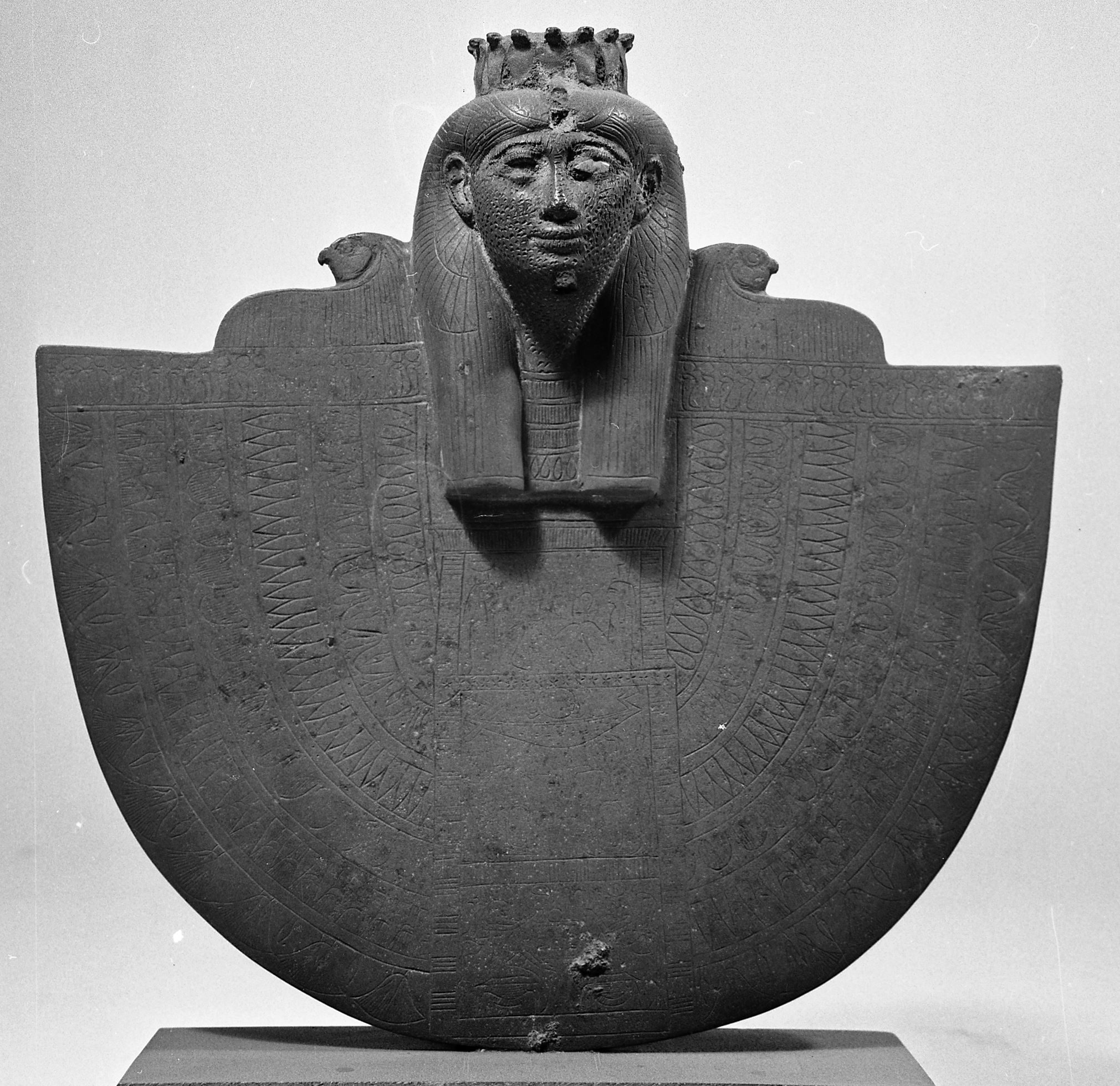
Aegis of Isis. The goddess wears a uraeiform modius. A rectangular recess is present on the upper part of the modius, containing a fragment, likely from the missing upper portion of the headdress. Isis wears a tripartite wig decorated with vertical lines and a vulture headdress, the head of which, originally cast separately, is missing. The plumage details are meticulously incised. The eyebrows and eyes of the goddess are recessed for the inlays. A light-brown inorganic material, possibly plaster used as adhesive, remains within the cavities, while the left eye preserves the inlay of a white stone, itself incised to receive a pupil. The entire surface of the face and neck is roughened by small, incised dots, likely intended to receive gilding on plaster. A near-rectangular lacuna is present on the chin, revealing the black and white casting core. Flanking the head of the goddess are two falcon heads in profile, showing the eyes, beak, and wings decorated with vertical incisions. The upper register of the collar is decorated with uraei crowned by solar discs. The wesekh collar comprises six registers, alternating narrow plain bands with broader bands featuring vegetal motifs. Three figurative scenes occupy the central section of the wesekh collar. In the upper scene, Isis and Nephthys are depicted crouching at the sides, with Osiris crouched at the centre. The figures are set within a naos featuring a cavetto cornice. In the second scene, beneath a starry sky, Isis and Nephthys are shown in profile, arms raised to support a boat carrying a solar disc flanked by two uraei. Two empty cartouches topped with feathers are placed between them, while a male deity, possibly Shu, stands at the centre with raised arms. The third scene depicts a central djed pillar crowned by two ostrich feathers and a solar disc, flanked by two crouching female deities on the nbw hieroglyph (Gardiner S12). The deity on the left raises her hands in protection of the djed pillar, while the one on the right holds a long, hooked implement towards the djed pillar. Two uraei on papyrus flowers flank the scene. On the back of the aegis, at the base of the wig is a fragment of the menat counterpoise, likely cast separately. Beneath the goddess’s head is a loop, partially occluded and obliterated. Two additional loops are present on the lower section of the wesekh collar. The object is made in the lost-wax technique. The collar is solid cast, while the head of the goddess may be hollow.